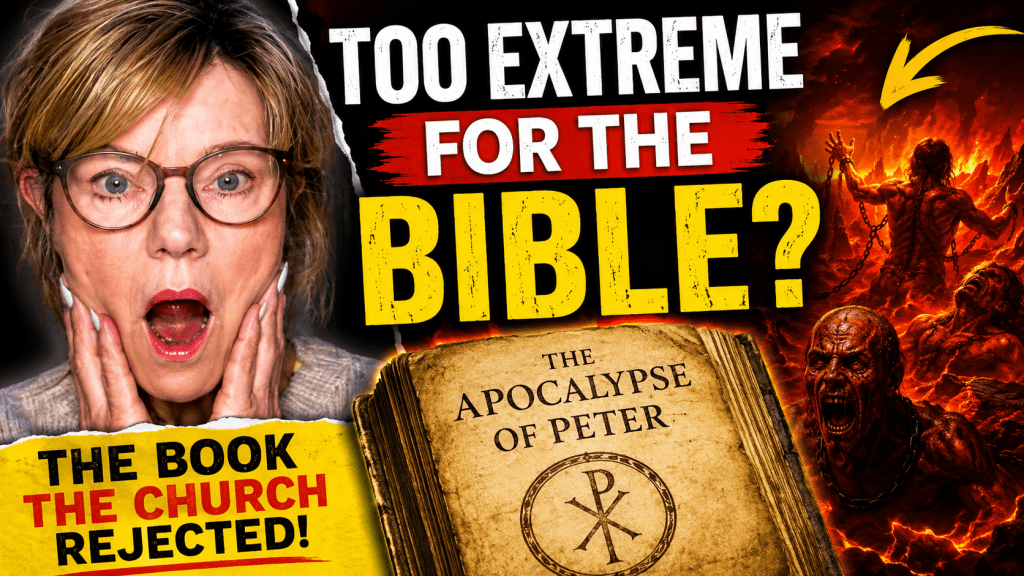
The Terrifying Christian Text Left Out of the Bible
Imagine discovering an ancient Christian text so horrifying, so graphic, and so controversial that early Christians debated whether it belonged in the Bible itself.
A book filled with visions of hell.
Blasphemers hanging by their tongues.
Adulterers suspended over rivers of fire.
The damned suffering punishments that mirrored the sins they committed in life.
This wasn’t medieval fantasy.
This was the Apocalypse of Peter — one of the most mysterious writings from early Christianity.
For a time, some believers considered it sacred Scripture.
So why did the Catholic Church reject it?
The answer reveals far more than most people realise about the formation of the Bible, the struggle against heresy, and the terrifying ways early Christians imagined eternity.
What Is the Apocalypse of Peter?
The Apocalypse of Peter is an early Christian text believed to have been written sometime in the early 2nd century AD, likely between 130–150 AD.
The book claims to contain revelations given directly by Jesus Christ to the Apostle Peter about heaven, hell, judgment, and the afterlife.
While parts of heaven are described, the text became famous for its horrifying depictions of hell.
The punishments are brutal and symbolic:
- Blasphemers are hung by their tongues.
- Murderers are cast into dark pits filled with venomous creatures.
- Adulterers hang over boiling mire.
- Persecutors of the righteous suffer endless torment.
- Women associated with abortion are shown enduring horrifying punishments beside the unborn children they destroyed.
The punishments follow a concept known as lex talionis — punishment mirroring the crime.
To modern readers, the imagery feels shocking, grotesque, and deeply disturbing.
But in the ancient world, these terrifying visions served as warnings about divine judgment and moral corruption.
The Earliest Christian “Hellscape”
What makes the Apocalypse of Peter historically important is that it may be the earliest surviving Christian text to give detailed descriptions of heaven and hell.
Long before The Divine Comedy by Dante Alighieri shaped popular imagination about the afterlife, Christians were already reading vivid apocalyptic visions like this one.
Many scholars believe the Apocalypse of Peter heavily influenced later Christian depictions of hell.
Its imagery echoes through medieval Christianity, art, sermons, and literature.
For centuries, fear of eternal punishment became one of the most powerful forces in Christian preaching.
And this ancient text helped shape that imagination.
Was the Apocalypse of Peter Almost in the Bible?
Surprisingly, yes.
Early Christianity did not immediately possess a finalized New Testament.
In the first few centuries after Christ, Christians read many different writings:
- Gospels,
- letters,
- apocalypses,
- acts,
- homilies,
- and theological reflections.
Church leaders had to discern which books were truly inspired by God.
The Apocalypse of Peter appears in the Muratorian Fragment — one of the earliest surviving lists of New Testament writings.
That means some Christians respected the text enough to consider it for public reading in churches.
However, even in those early centuries, many bishops and theologians expressed deep concerns.
Eventually, the Church concluded it should not be included in the biblical canon.
Why the Catholic Church Rejected It
1. Doubtful Authorship
The biggest problem was authorship.
The text claimed to come from the Apostle Peter.
But historians and Church leaders realised it was written long after Peter’s death.
Peter was martyred in the 1st century.
The Apocalypse of Peter was written decades later.
This meant the book was pseudepigraphical — falsely attributed to an apostle to gain authority.
The early Church took apostolic authority very seriously.
For a book to become Scripture, it generally needed:
- direct apostolic authorship,
- eyewitness connection to Jesus,
- or acceptance by churches founded by the apostles.
The Apocalypse of Peter failed this test.
And that mattered enormously.
The Church was not simply asking:
“Is this book dramatic?”
It was asking:
“Did this genuinely come from the apostolic faith handed down from Christ?”
2. Problematic Theology
Another major issue involved theology.
Some surviving versions of the Apocalypse of Peter suggest that the punishments of hell may not be eternal.
In some traditions, saints appear able to intercede for the damned so they might eventually be saved.
This resembles a form of universalism — the belief that all souls may ultimately be redeemed.
That directly conflicted with emerging orthodox teachings regarding eternal judgment and damnation.
As Christianity battled heresies and theological confusion in the 2nd and 3rd centuries, Church leaders became increasingly cautious about texts promoting speculative doctrines.
There were also concerns about Gnostic influence.
Some early Christian writings claimed to reveal hidden spiritual secrets available only to a select few.
The Church strongly resisted this trend, insisting that the Gospel was public truth handed down openly from the apostles — not secret mystical knowledge.
3. Fear-Based Spirituality
The text’s graphic imagery also troubled many Church leaders.
The Apocalypse of Peter can feel obsessed with terror.
Its descriptions are emotionally overwhelming.
Some theologians worried this distorted the Christian message.
Christianity is rooted in:
- repentance,
- grace,
- mercy,
- redemption,
- and union with Christ.
But apocalyptic fear can easily dominate faith when graphic punishment becomes the centre of religious imagination.
The Church ultimately concluded that while the text might contain moral lessons, it did not reflect the balanced theological vision required for inspired Scripture.
The Church Didn’t “Hide” the Book
One of the biggest myths online is that the Catholic Church “removed books from the Bible” to hide uncomfortable truths.
But the reality is more complex.
The Apocalypse of Peter survived precisely because Christians preserved it.
Fragments were rediscovered in Egypt in 1887 at Akhmim, alongside other ancient Christian writings.
The Church did not erase history.
Instead, early Christians debated which writings truly belonged in the canon.
The New Testament was formed through centuries of discernment.
The Church looked for:
- apostolic origin,
- doctrinal consistency,
- widespread use in worship,
- and harmony with the faith received from the apostles.
The Apocalypse of Peter ultimately failed those tests.
So it became part of the New Testament Apocrypha rather than canonical Scripture.
Why This Matters Today
The Apocalypse of Peter remains fascinating because it opens a window into the fears, hopes, and theological struggles of early Christians.
It shows believers wrestling with:
- justice,
- suffering,
- eternity,
- punishment,
- mercy,
- and salvation.
It also reminds us that the Bible did not simply “fall from heaven.”
The canon was carefully discerned over centuries.
And whether one agrees with the Church’s decision or not, the rejection of the Apocalypse of Peter reveals how seriously early Christians guarded apostolic truth.
Even today, the book continues to provoke debate.
Should Christians read it?
Does fear lead people toward God?
Or does the Gospel call believers beyond terror into love, repentance, and transformation?
Perhaps that is why this ancient text still unsettles readers nearly 2,000 years later.
The Apocalypse of Peter is one of Christianity’s most haunting forgotten texts.
Filled with terrifying visions of hell and controversial theology, it nearly entered the New Testament before the Church ultimately rejected it.
Its exclusion shaped Christian history forever.
But its survival reminds us that early Christianity was far more complex, contested, and dramatic than many people realise.
And perhaps that’s exactly why people are still talking about it today.




Thanks for your Visit Here, feel free to leave a comment 💟