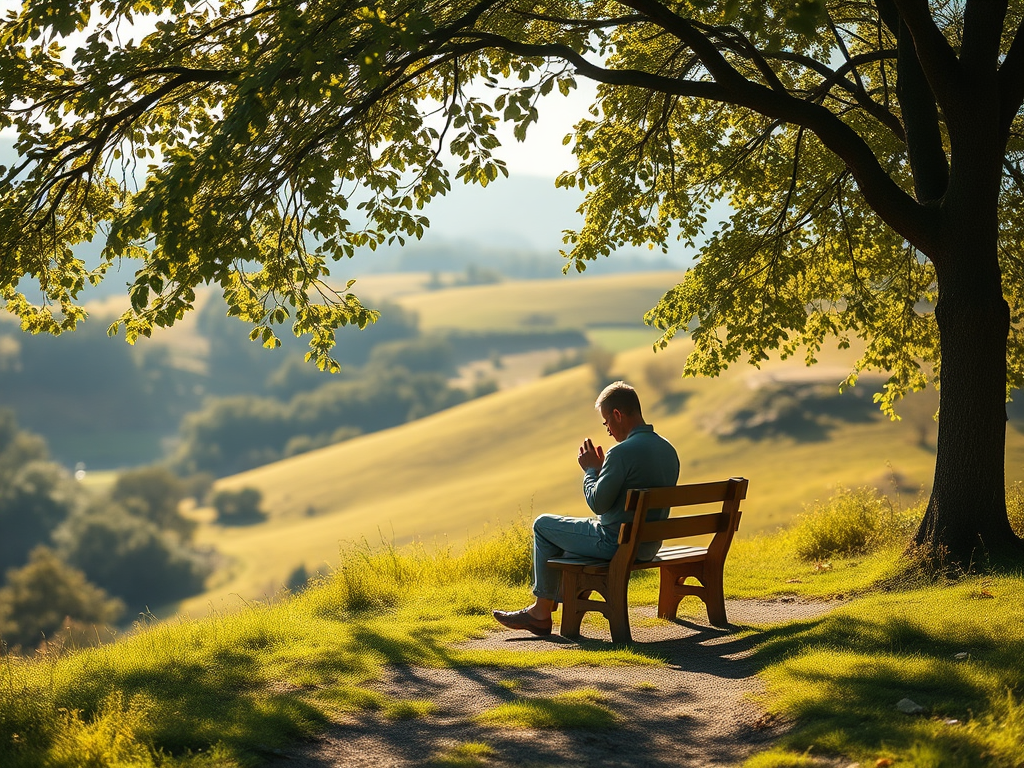
In its simplest form, ‘Retreat’ means ‘to withdraw, to draw back.’ Throughout the ages, the Christian tradition has recognized Retreat as an important part of spiritual formation. Time consciously set aside for God, a change of focus, is a deliberate act of stepping outside of normal routine.
Often I go Hiking alone and find its a a wonderful retreat from the business of Life. I’ve got time to think and pray while enjoying Gods creation.
We need to escape from responsibilities to be in a quiet place. A place where all our senses are open and ready to listen to God.
Retreat is Prayer
Prayer is understood as developing a deep awareness of God in all of life. The goal of our retreat is to be as fully present as we can be to God. Present with ourselves and the moment. This is quality time to re-collect, re-member, re-examine. Which is important and central- and to find healing, find wholeness (shalom). In the presence of God, there is joy evermore.
Psalm 16:11 New Living Translation
You will show me the way of life, granting me the joy of your presence and the pleasures of living with you forever
Retreat is a recognition of the need to be with myself for a time to think, pray, and reflect. Reflect on ‘who I am, what I am, where I am’ in relation to God, self, others, and the world.
https://paularoseparish.substack.com
https://www.youtube.com/@PulpitToPew
https://creators.spotify.com/pod/profile/paula-rose-parish
People go on retreat to seek God through time apart, which is why it’s important to provide a context and framework for retreat solitude, stillness, time for prayer and reflection, time for God, time to stop, and time to talk and share, things that are not always possible in the demands of normal everyday life.
Retreat is Pilgrimage
As followers of Jesus, we are all part of an ongoing faith journey from ‘captivity to freedom’, which takes place in the ‘landscape of the heart’. Retreat is a pilgrimage because it is ‘the symbolic acting out of an inner journey’. We begin to take stock of our lives and look for that which really counts.
In 2013, I packed up my backpack with my possessions, including my microfiber towel. I put on my walking shoes and travelled on a pilgrimage in northern Spain called the Way of Saint James, in the footsteps of Jesus ‘ brother. It is also called Camino De Santiago.
It is the oldest pilgrimage walk in the world, and I was privileged to walk at least 70 kilometres of it. Another blog post will detail my adventure. However, leading retreats in a small country chapel in the depths of beautiful South Wales is reminiscent of my journey in Northern Spain. Why?
Because the journey I took in Northern Spain was more than a physical walk. It was walking in the way with the Lord Jesus Christ every day, speaking with him and he with me. It was hard, very hard physically and mentally, as I was 59 and far from fit. But the very special thing is that I had the space to be in the wilderness in the company of the Creator of the universe, the High God YAWAH- 24/7 and other pilgrims I met along the way-can’t get better than that.
Every day I worshipped in churches along the way whose languages I didn’t understand, but I felt God’s presence keenly. And when I’m in the little country Chapel called Tabernacle, in the depth of South Wales, which I am the Minister of, in the midst of leading others in retreat, I am in the wilderness in the company of the Creator of the universe, the Highest God YAWAH – can’t get better than that. Come aside and rest awhile, come along to a retreat.
This often requires that we take steps to set aside the pressures and demands for a time and ‘return to the heart’.
Hence, retreat is a journey to the centre of the spiritual world of our own inner life, and as such, we need to beware & be aware that retreat is not always a nice place to be, as it often exposes our hearts. To stop, to withdraw from the pace of life, allows those things we suppress to come to the surface.
So, to truly open our hearts to God often means we discover what Thomas Merton called ‘the inner contradictions’ and ‘chaotic forces’ happening all around us/within us. Retreat can bring us face to face with the ‘in between place’ of our old comfort zones and the huge changes of a ‘nothing makes sense’ new-age culture in an increasingly postmodern world. It is not a fun place to be. Think, for example, of Israel in the desert, Joseph in the pit, Jonah in the belly of the whale, John the Baptist in prison, the three Mary’s tending the tomb, and you get the idea.
With this understanding, we can see that retreat is not an escape from reality but a very real engagement with it, often about facing the truth about oneself. So, when we take a retreat, we must bear in mind that God is at work and that the inner-journey stuff is not always pretty.
We can also see that the purpose of retreat is to dispel illusion, set aside distraction and begin to penetrate the superficiality that deadens sensitivity to God. It is the opposite of a ‘spiritual ostrich’ attitude of burying your head in the sand.
Retreat is Perspective
This is the greatest benefit of retreat: it offers fresh ways of seeing and opens new possibilities, enabling ‘familiarity to no longer breed contempt’. Perspective gives the ability to see a situation objectively, stepping back to gain a bigger view, like seeing a circus parade from an upstairs window rather than through a hole in the fence at ground level. It is to see things as others do, and especially as God sees them!
This is our principal aim in going on retreat to stop, listen, reflect, pray, share so that we see with new eyes, think with new minds, so that even though we have to go back into the very same situations, the same set of circumstances, the same roles, responsibilities and relationships that we left behind to come to the place of retreat, we do so having changed inside.
Retreat helps us get everything back in place, not a distorted view that is overblown or grotesquely out of synch (think of fairground mirrors), but a true reflection of what is. Thomas Merton said, ‘Where you are is where you belong, this is it’ and an acknowledgement of this gives the only platform for real growth as it’s not the fantasy of the ‘if only’ nor the fiction of ‘what if’ but the fact of ‘this is me, this is where I’m at’, this is where I begin the rest of my life.
It is therefore a strategic retreat: withdrawing to advance. The whole purpose of prayer, pilgrimage and perspective in retreat is to bring renewed hope for the everyday comings and goings of life as it is for us. This can happen because a renewed perspective brings us to a place where true priorities are reordered, a sense of direction is renewed, and the right kind of action is resolved.
Preoccupied with being Occupied
To quote Henri Nouwen we ‘can be preoccupied with being occupied.’ To be too busy, on the go all the time, not only brings exhaustion without, but also a fragmentation within. This results in a disconnection (with self, family, church, God), leading to compartmentalisation, resulting in ‘a vague discontent where our lives stagnate in a resigned acceptance’, preventing us from actively seeking new discoveries of God.
Retreat helps us dispel this murkiness of discontent by looking honestly at ourselves in relation to God. In this, we need to be gentle with ourselves & others, as sometimes, tired and battle-scarred, we simply need the healing of space to rest and be restored. To be aware of this is to seek out Jesus and rediscover his grace.
The bottom line is this: God is worthy of our time; all else is a bonus. It’s not about success, achievement or anything other than being open to God, the God of surprises and those moments of serendipity.
The measure of what you sow in diligence and discipline will be the measure of what you reap from your days of retreat. Expect to know yourself better. Expect to be more aware of a sacramental world; to be content with God alone; to be changed from the inside out.
But above all, remember the principal purpose is to seek God for himself as the ‘one thing necessary’ so as to learn to ‘love him with all your heart, soul, mind and strength’.
☕ If you’d like to support what I am doing: Buy Me a Coffee. If you find my videos & writing inspiring and uplifting, consider supporting what I do. Buy me a coffee. Your support makes a difference in my life and helps me create more of what you and I like. Thank you



Thanks for your Visit Here, feel free to leave a comment 💟