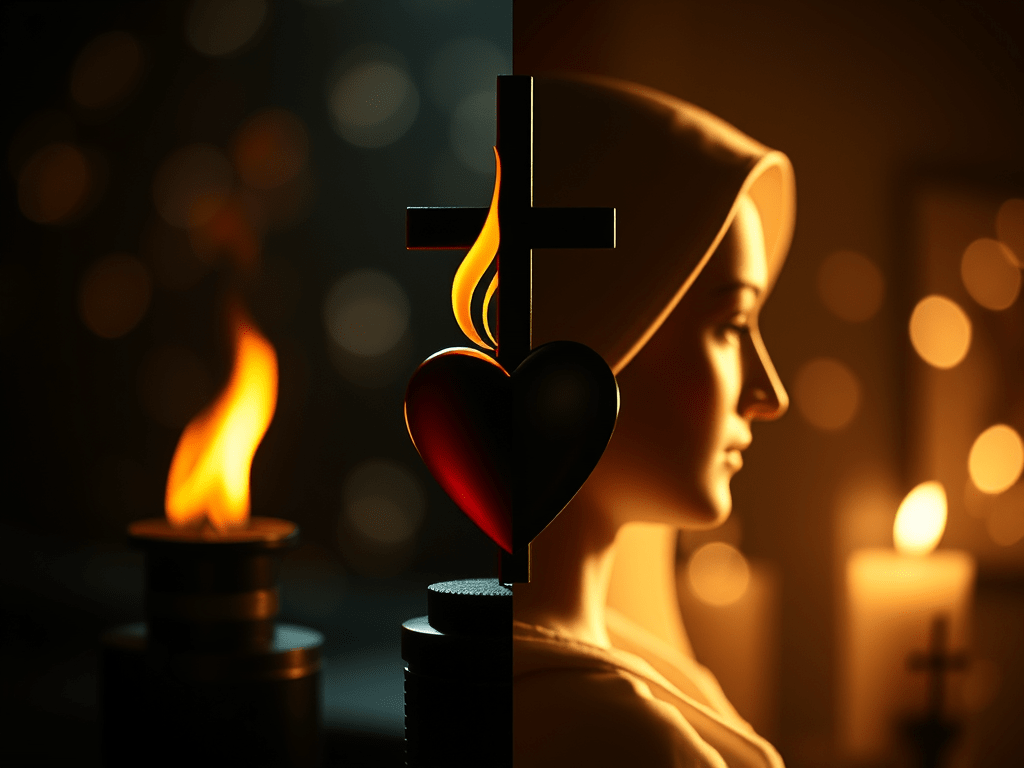
A Catholic Theological Perspective
Throughout Catholic history, the Virgin Mary has been honoured not only as the Mother of God but also as an active participant in God’s plan of salvation. From her humble “yes” at the Annunciation to her presence at the foot of the Cross, Mary’s role is inseparable from the mission of Christ. Catholic theology also teaches that her maternal mission continues until the end of time—especially in what Scripture and Tradition refer to as the “last days.”
This article explores the role of the Virgin Mary in the last days according to Catholic theology, drawing from Scripture, the Church Fathers, the Catechism, and approved Marian apparitions.
Mary in Salvation History
To understand Mary’s role in the last days, we must first see her place in salvation history.
The Catechism of the Catholic Church teaches that Mary is “intimately united with her Son’s saving work” (CCC 964). Her cooperation begins with the Incarnation and continues through the Church’s pilgrimage on earth.
The Church sees Mary as:
- The New Eve, whose obedience unties the knot of Eve’s disobedience (St. Irenaeus)
- The Mother of the Redeemer
- The spiritual Mother of all the living in Christ
This ongoing maternal role naturally extends to the final stages of human history.
Biblical Foundations for Mary’s Role in the Last Days
The Woman of Genesis 3:15
The first prophecy of redemption appears in Genesis:
“I will put enmity between you and the woman, and between your offspring and hers; he will strike at your head, while you strike at his heel.”
Catholic tradition sees this “woman” as Mary, whose offspring—Jesus Christ—defeats Satan. The total enmity between Mary and the serpent suggests her unique role in the final battle between good and evil.
The Woman Clothed with the Sun (Revelation 12)
One of the most important biblical passages regarding Mary and the last days is Revelation 12:
“A great sign appeared in the sky, a woman clothed with the sun… She gave birth to a son, destined to rule all the nations.”
The Church understands this woman as representing both Mary and the Church. The chapter depicts:
- Spiritual warfare
- Satan’s final rage
- God’s protection of the woman and her offspring
Mary appears here not as passive, but as a central figure in the cosmic struggle leading to Christ’s final victory.
Mary as the Mother of the Church in the Last Days
At the Cross, Jesus entrusts Mary to the beloved disciple:
“Behold, your mother” (John 19:27)
Catholic theology understands this moment as the formal beginning of Mary’s spiritual motherhood of the Church.
As the Church faces increasing trials in the last days—apostasy, moral confusion, persecution—Mary’s maternal role becomes especially urgent. Vatican II teaches:
“Taken up to heaven, she did not lay aside this saving office, but by her manifold intercession continues to bring us the gifts of eternal salvation” (Lumen Gentium, 62).
Mary’s role is not to replace Christ, but to lead souls to Him, especially in times of darkness.
Approved Marian Apparitions and the Last Days
While public revelation ended with the death of the last apostle, the Church recognises certain private revelations as helpful for living the Gospel more fully.
Several approved Marian apparitions emphasise Mary’s role in preparing humanity for spiritual trials.
Our Lady of Fatima (1917)
At Fatima, Mary warned of:
- Sin and moral decay
- The spread of errors
- Chastisements if humanity did not repent
She also gave a message of hope:
“In the end, my Immaculate Heart will triumph.”
Fatima highlights Mary as a refuge, a call to conversion, and a sign of God’s mercy before judgment.
Our Lady of Guadalupe (1531)
Though centuries earlier, Guadalupe is deeply relevant to the last days. Mary appears as a woman “clothed with the sun,” an echo of Revelation 12. Her appearance led to the conversion of millions and demonstrates her role as an evangelizer and mother to all peoples.
Mary and the Final Triumph of Christ
Catholic theology is clear: Jesus Christ alone is the Saviour and Judge of the world. Mary’s role is entirely dependent on Him.
However, God chooses to involve human cooperation in His plan. Just as Mary cooperated in Christ’s first coming, she is seen as cooperating spiritually in His final victory.
St. Louis de Montfort wrote:
“Mary must shine forth more than ever in mercy, in power, and in grace in the latter times.”
This does not mean worship or equality with God, but rather God’s choice to work through humility and obedience—qualities Mary embodies perfectly.
Devotion to Mary in the Last Days
The Church consistently encourages Marian devotion as a safeguard for faith.
Practices such as:
- The Rosary
- Consecration to the Immaculate Heart
- Imitation of Mary’s virtues
are seen as powerful spiritual weapons—not because of Mary herself, but because they lead souls closer to Christ.
As Pope St. John Paul II said:
“Totus Tuus”—Totally Yours—reflects total belonging to Christ through Mary.
Conclusion: A Mother for the End Times
In Catholic theology, the Virgin Mary is not a distant figure of the past. She is a living, active mother who accompanies the Church through history and into its final trials.
In the last days, Mary’s role can be summarised as:
- A sign of hope
- A mother calling her children to repentance
- A model of faith and obedience
- A participant in Christ’s ultimate victory over evil
Far from promoting fear or speculation, authentic Marian devotion fosters deeper trust in Christ, stronger faith, and perseverance to the end.
As Scripture reminds us:
“Blessed is she who believed that the promise made her by the Lord would be fulfilled” (Luke 1:45).
For Inspirational Videos Click HERE




Thanks for your Visit Here, feel free to leave a comment 💟