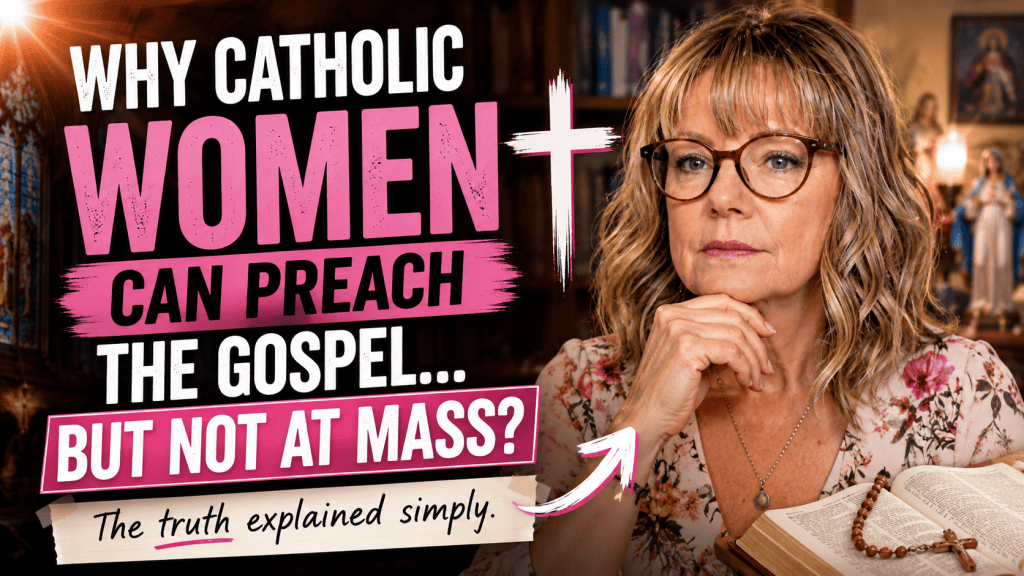
Why the Most Influential Catholic Women Aren’t Standing Behind the Pulpit
By Paula Rose Parish
As a former Protestant pastor, I once measured ministry by one thing above all else: preaching.
Week after week, I stood behind a pulpit believing that proclaiming God’s Word from the front of a church was one of the highest callings a Christian could receive. So, when I began exploring the Catholic faith, one question kept resurfacing:
If Catholic women can proclaim the Gospel, why can’t they preach the homily during Mass?
For a long time, I assumed the Catholic Church was limiting women’s ministry.
Today, I believe the exact opposite.
I Was Asking the Wrong Question
Looking back, I realise my thinking was shaped by my Protestant experience, where ministry is often closely identified with preaching from the platform.
The Catholic Church challenged that assumption.
Instead of asking,
“Why can’t women preach the homily?”
I began asking,
“Where is God already calling women to proclaim Christ?”
That changed everything.
A Quiet Revolution
If you’ve only followed headlines about debates over women’s ordination, you may have missed something remarkable.
Across the Catholic Church today, faithful women are carrying the Gospel into places many priests never reach.
They are:
- leading evangelisation initiatives
- directing Catholic charities
- teaching theology in universities
- serving in diocesan leadership
- producing podcasts, books and YouTube channels
- working as canon lawyers
- leading catechetical formation
- accompanying families in parish life
- serving as missionaries around the world
Far from silencing women, the Church is encouraging their gifts in countless ways.
Pope Francis and Women’s Ministry
Recent years have seen significant developments.
Pope Francis formally opened the instituted ministries of Lector and Acolyte to women through Spiritus Domini (2021), recognising ministries that many women had already been faithfully carrying out.
He also established the instituted Ministry of Catechist through Antiquum Ministerium (2021), recognising the indispensable role of those who hand on the faith. I have been asked by my dieoese to engage in this program and currently working my way through the studies.
During the Synod on Synodality, bishops, priests, religious and lay people repeatedly spoke about expanding women’s participation in consultation, leadership and decision-making.
At the same time, the Church reaffirmed her understanding of Holy Orders.
That distinction matters.
The Difference Many People Miss
The Catholic Church joyfully encourages women to proclaim Christ.
What she does not do is permit lay people—whether women or men—to preach the homily during Mass.
Why?
Because the homily is not simply a speech or Bible study. It is part of the Church’s liturgy and is entrusted to bishops, priests and deacons as an exercise of their ordained ministry.
This isn’t about limiting women’s voices.
It’s about preserving the integrity of the liturgy as the Church has received it.
Faithfulness Is More Than Personal Preference
Occasionally, stories emerge of parishes where lay people, including women, are invited to deliver what is presented as the homily during Mass, despite the Church’s liturgical norms.
These situations often generate confusion.
The issue is not whether those women are gifted communicators. Many undoubtedly are.
The real question is whether any of us—lay or ordained—have the authority to set aside the Church’s liturgical discipline when we personally disagree with it.
As Catholics, our unity is built not only on shared beliefs but also on shared worship.
The Women Who Inspire Me
One of the greatest joys of becoming Catholic has been discovering women whose influence reaches far beyond any pulpit.
Some teach in universities.
Some write books that shape generations of Catholics.
Some quietly form children in the faith.
Some lead charitable ministries serving the poorest in society.
Others use digital media to proclaim Christ to millions across the globe.
Their ministries look different, but their witness is no less powerful.
They remind us that the Gospel has never depended on a microphone.
Continue the Conversation
It has always depended on faithful disciples.
This article only scratches the surface.
On my YouTube channel, I explore why the Catholic Church distinguishes between proclaiming the Gospel and preaching the homily during Mass, and how that changed my understanding as a former Protestant pastor.
YouTube video: Can Catholic Women Preach the Gospel?
For Premium Substack subscribers, I’ve prepared an extended theological study examining Scripture, the Catechism, recent papal documents, the Synod on Synodality, and the rich tradition of women’s ministry in the Catholic Church.
🤿For a DEEPER DIVE -Premium Link to written article https://paularoseparish.substack.com/p/what-does-authentic-catholic-womens?r=77gw2m&utm_campaign=post&utm_medium=web&showWelcomeOnShare=true
If you’ve ever wrestled with these questions, I hope you’ll join me there.
Sometimes the most important discoveries begin not by asking what we cannot do, but by discovering the extraordinary mission Christ has already entrusted to us.
Discover why Catholic women are called to proclaim the Gospel worldwide while the homily at Mass remains part of the ordained ministry of the Church.
#womenCatholicChurch #Catholicwomenministry #Catholichomily #womenministry
#Apologetics



Thanks for your Visit Here, feel free to leave a comment 💟